.jpg)
—and how technology leaders can prove its ROI
Platform Engineering has moved from nice-to-have to strategic priority for mid-sized and large enterprises—particularly in regulated industries where resilience, velocity, and compliance must coexist.
Yet many CIOs, CTOs, and Heads of Cloud still struggle to articulate the tangible business value of platform engineering to non-technical stakeholders.
Having faced this situation in previous roles in our careers, our team decided to help technology leaders craft a compelling business case, quantify ROI, and position platform engineering as a core capability that accelerates digital transformation while reducing operational risk.
Why Platform Engineering Now?
Over the last five years, enterprises have been drowning in complexity:
- Over-fragmented toolchains
- Hundreds of microservices
- Multi-cloud sprawl
- Security exposures created by accelerated delivery
- Rising regulatory and audit burden
Platform Engineering emerged as a disciplined approach to build Internal Developer Platforms (IDPs), automate guardrails, and standardize delivery workflows—so teams can ship faster, safer, and at lower cost.
In regulated industries, it directly strengthens three pillars:
- Predictability (standardized pipelines, policy-as-code, repeatable deployments)
- Security (golden baselines, immutable environments, automated compliance checks)
- Productivity (self-service dev portals, reusable blueprints, curated golden paths)
Yet the executive decision to invest heavily in platform engineering requires a rigorous business case.
Part 1: The Core Components of a Strong Platform Engineering Business Case
Below are the components that visionary technology leaders include when building the case.
1. Define the Business Problems Driving the Investment
Executives buy outcomes, not pipelines. Frame the problem in terms of business impact.
Common pain points:
- Long lead times for environment provisioning or approvals
- High change failure rate due to inconsistent dev/test environments
- Duplicate tooling across teams creating wasted spend
- Low developer productivity (40–60% of time spent on non-core work)
- Audit & compliance friction, causing release delays
- Escalating cloud costs due to unmanaged sprawl
- Talent retention challenges from poor engineering experience
Mapping these pains to financial impact sets up the business case.
2. Demonstrate the Value of Standardization and Golden Paths
Platform engineering reduces cognitive load and eliminates the “choose your own adventure” chaos across teams.
Golden paths can create:
- 2× faster onboarding for developers
- 30–50% fewer deployment errors
- Up to 70% faster environment creation
Executives respond strongly to quantification. Back your numbers with industry data or insights from similar companies (e.g., Infiligence’s platform engineering benchmarks).
3. Quantify Developer Productivity Gains
Developer time is expensive—often the largest operational expense in a tech organization.
Example ROI framing:
If you have 120 engineers, each losing 8 hours/week to friction:
- 120 engineers × 8 hours = 960 hours/week lost
- 960 hours × $90/hr fully loaded = $86,400/week
- Annualized loss = $4.49M per year
Even a 30% reduction yields $1.3M saved annually. This alone often justifies platform investments.
4. Show Impact on Delivery Velocity and Time-to-Market
Time-to-market is a revenue driver in every regulated industry.
Examples:
- A bank that accelerates new product releases by even 20% gains competitive advantage.
- A pharma company that reduces validation cycles accelerates clinical and FDA timelines.
- A healthcare provider can roll out secure patient services faster.
Speed is money—explicitly tie platform engineering to revenue velocity.
5. Connect to Risk Reduction and Compliance Efficiency
Executives in regulated industries care deeply about:
- Incident reduction
- Faster recovery
- Stronger compliance posture
Platform engineering provides:
- Blueprinted environments
- Automated policy enforcement
- Secure-by-default patterns
- Centralized observability and governance
Quantify:
- Mean Time to Recovery (MTTR) improvement
- Reduction in P1 incidents
- Audit prep hours saved
- Breaches avoided
Even one major security incident avoided can justify the investment many times over.
6. Map the Cost of Doing Nothing
IMPORTANT: This is the single most powerful weapon in a business case.
The cost of inaction includes:
- Developer attrition (high)
- Talent hiring costs
- Release delays
- Production outages
- Compliance failures
- Cloud waste
- Technical debt accumulation
Executives must clearly see that not investing is more expensive than investing.
7. Provide a Phased Investment Plan
A business case is stronger when it is not “all or nothing.” Recommended phases:
Phase 1: Assess
- Toolchain assessment
- Developer experience surveys
- Delivery metrics baseline
- Compliance & risk mapping
Phase 2: Engineer
- Build core IDP elements
- Golden paths & templates
- Policy-as-Code
- Self-service catalog
- Foundational security controls
Phase 3: Accelerate
- Cross-team rollout
- Training & onboarding
- Measurement dashboards
- FinOps, DevSecOps, SRE enablement
This mirrors Infiligence’s Assess → Engineer → Accelerate model and provides a clear roadmap for executives.
Part 2: How Technologists Can Prove the ROI of Platform Engineering Investments
This is where the business case becomes measurable. Below is a framework used by leading CIOs, CTOs, and platform engineering teams.
1. Establish Pre-Investment Baselines
Track at least:
- Lead Time for Changes
- Deployment Frequency
- Change Failure Rate
- MTTR
- Percentage of automated deployments
- Time to onboard a new developer
- Time spent on non-core engineering tasks
- Cloud cost per application/team
- Environment provisioning time
- Audit finding count
This provides the “before” picture.
2. Attach Every Metric to Dollars
Executives care about economic value.
Examples:
- Reducing MTTR by 30% = fewer revenue-impacting outages
- Saving 100 developer hours/week = $500K/year
- Reducing cloud waste by 20% = $1–2M/year
- Lowering audit preparation time = direct OPEX savings
Always convert gains into financial language.
3. Use the 4 Categories of ROI for Platform Engineering
A. Productivity ROI
- Developer hours reclaimed
- Faster onboarding
- Reduced context switching
- Fewer manual tasks
B. Velocity ROI
- Faster release cycles
- Reduced wait time
- Faster experimentation
C. Quality and Stability ROI
- Lower change failure rate
- Reduced incidents
- Lower downtime costs
D. Compliance ROI
- Automated evidence gathering
- Lower audit costs
- Reduced regulatory exposure
Executives resonate strongly with this structure.
4. Build an ROI Dashboard
A standard dashboard should include:
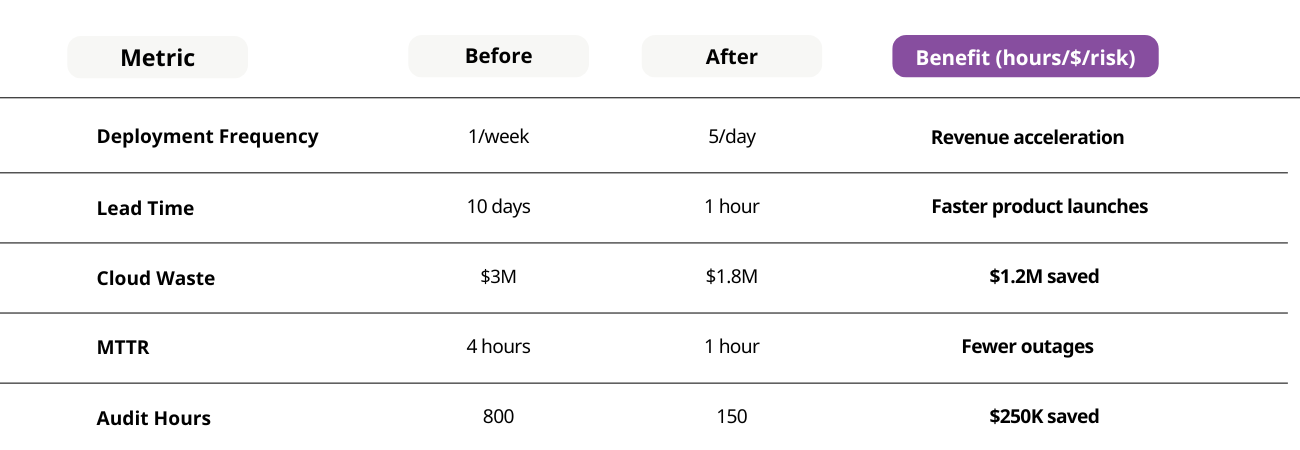
This dashboard can be used in:
- Quarterly business reviews (QBR)
- Board updates
- Budget conversations
- Renewal/expansion pitches (internal)
5. Tie Platform Engineering to Strategic Outcomes
Use language like:
- “Platform engineering reduces risk surface by enforcing golden controls.”
- “We can now onboard developers 60% faster and hit product delivery commitments.”
- “Our audit preparation time has decreased from 6 weeks to 1 week.”
- “Security drift has reduced by 40% with immutable, policy-as-code environments.”
This converts engineering effort into business leadership language.
6. Highlight Team Impact & Culture Shift
A strong platform reduces:
- Cognitive load
- Operational toil
- Burnout
It increases:
- Talent retention
- Cross-functional collaboration
- Developer satisfaction (measured via NPS)
Executives increasingly treat developer experience as business strategy—especially post-COVID and with rising attrition.
7. Build Case Studies from Within the Org
Technologists can demonstrate internal wins such as:
- “Team X reduced deployment time from 3 hours to 15 minutes.”
- “Team Y achieved zero-config onboarding with golden templates.”
- “Team Z eliminated two major P1 incidents in 90 days.”
Internal stories are often more persuasive than external references.
Part 3: A Sample Executive Summary You Can Use
Platform Engineering enables us to reduce developer toil, standardize delivery, eliminate tool fragmentation, enforce security baselines, accelerate time-to-market, and improve compliance posture.
With platform engineering, we can save between 20–40% of engineering hours, reduce incidents by 30–50%, cut audit time by 60%, and lower cloud waste by 15–25%.
This investment strengthens operational resilience, improves velocity, and reduces long-term cost—making our engineering organization more predictable, secure, and innovative.
Closing Thoughts: Platform Engineering Is an Organizational priority
Enterprises that adopt platform engineering early outperform their competitors in:
- Productivity
- Security
- Compliance
- Modernization
- Talent retention
- Innovation velocity
The business case is not only about cost savings—it’s about becoming a software-defined business where engineering is strategic, not reactive.
Building a successful Platform Engineering capability requires more than tools, templates, or a new team structure. It demands:
- Deep experience across cloud, DevSecOps, SRE, and compliance
- Strong engineering discipline
- A proven understanding of regulated industries
- The ability to design golden paths that actually get adopted
- A culture of automation, observability, and secure-by-default delivery
- Leaders who have done this before—at scale
Most mid-sized companies and even large enterprises struggle to assemble this expertise in-house. Hiring, training, and retaining a senior platform engineering team—architects, SREs, DevSecOps specialists, and security engineers—can take 12–18 months and cost millions before any measurable value is realized.
This is why partnering with a credible, proven Platform Engineering partner becomes not just a shortcut—but a strategic advantage.
At Infiligence, our team has over their careers spent decades building mission-critical platforms across most regulated industries and environments.
We bring:
- Proven blueprints and golden paths that accelerate adoption
- Industry-grade platform architectures built for compliance, scale, and security
- Accelerators and IP (iTest, iDataGen, iRule, Conektto) that reduce build time
- A modular engagement model (Assess → Engineer → Accelerate) tailored to your maturity
- Fast ROI realization, not multi-year experiments
Whether you're starting from zero, modernizing existing pipelines, or scaling engineering efficiency across hundreds of developers—Infiligence ensures you get it right the first time.

